… A One to two sentence North Star for how you want to feel in your life
Ask most people what they should be doing for their health, and the list comes quickly. Drink more water. Move more. Go to bed earlier. Eat more vegetables. We know the list. Most of us could recite it in our sleep, if we were getting enough of it.
Now here’s a different question: how do you actually want to feel?
People often pause here, they might even laugh. Maybe even shrug and say "less tired, I guess." We spend so much time on what to do that we rarely stop to name what we're doing it for.
That's where a wellness vision comes in. Goals tell you what to do. A wellness vision tells you who you're becoming and why it matters to you. And no, it isn't a vision board you hang up in January and forget by February. It's lighter than that, and more useful. It's yours, and it can start with a single sentence.
What is a wellness vision?
A wellness vision is a short statement, just one or two sentences, that describes how you want to be and feel in your life. It starts with "I am" or "I feel," and it's written as if it's already true.
That last part matters. A goal points at something ahead of you: lose ten pounds, walk 10,000 steps, cut back on sugar. A wellness vision describes the person you're growing into, in the present tense. It isn't a number, a deadline, or a rule. It's a state of being.
Here's mine:
I am grounded, connected and present in each moment.
I chose those words because they give me room to slow down, listen to whats actually happening whether in my body, a conversation or even just everyday life and practice giving grace and care to myself and others. When I'm grounded, I can hear what my body is asking for. When I'm connected, I show up for myself and for the people I love. When I'm present, I stop living three steps ahead of my own life. Everything I do for my health, from how I move, rest or even socialize, feeds my wellness vision.
Why it works when goals alone don't
It gives your choices a reson. Goals can feel like homework. A vision gives the small, everyday decisions something to line up with. Skipping the third cup of coffee isn't about following a rule anymore. It's about feeling grounded instead of jittery.
It's built on friendship with your body. So much health advice starts from "What's wrong with me?" A wellness vision asks a kinder question: "What does my body need to feel this way?" That shift moves you from fixing yourself to being in relationship with yourself. And you may already be a better friend to your body than you give yourself credit for. A vision simply helps you do it on purpose and in alignment with your values.
It bends without breaking. Life has seasons. Some months you have energy and time; some months you're just getting through. How you show up can change with your season while the vision holds steady. You don't have to start over every time a plan falls apart.
It's where coaching begins. In my first session with every client, we create a wellness vision together, because everything else we do builds on it. It's also a well-established tool in health and wellness coaching. When people can name how they want to feel, the steps to get there become much clearer.
How to create your own
You don't need a retreat or a free weekend for this. Give yourself fifteen quiet minutes and something to write with. I like to walk through it the same way I approach most things: pause, listen, practice.
1. Pause. Find a spot where you won't be interrupted. Take a few slow breaths. Then ask yourself: six months from now, how do I want to feel in my body and in my days? or, how do I want to be consistently?
2. Listen. Write down whatever words come up, without editing or judging them. Notice the words you don't want, as well; they're clues. A few prompts can help:
When I feel my best, I am…
I want more ___ in my days.
I want to feel ___ as I navigate the day.
3. Practice. Look over your words and circle the ones that feel true, or almost true. Shape them into one or two sentences that begin with "I am" or "I feel." Read it aloud. If it makes you tense up, swap a word. If it makes you breathe a little easier, you're close.
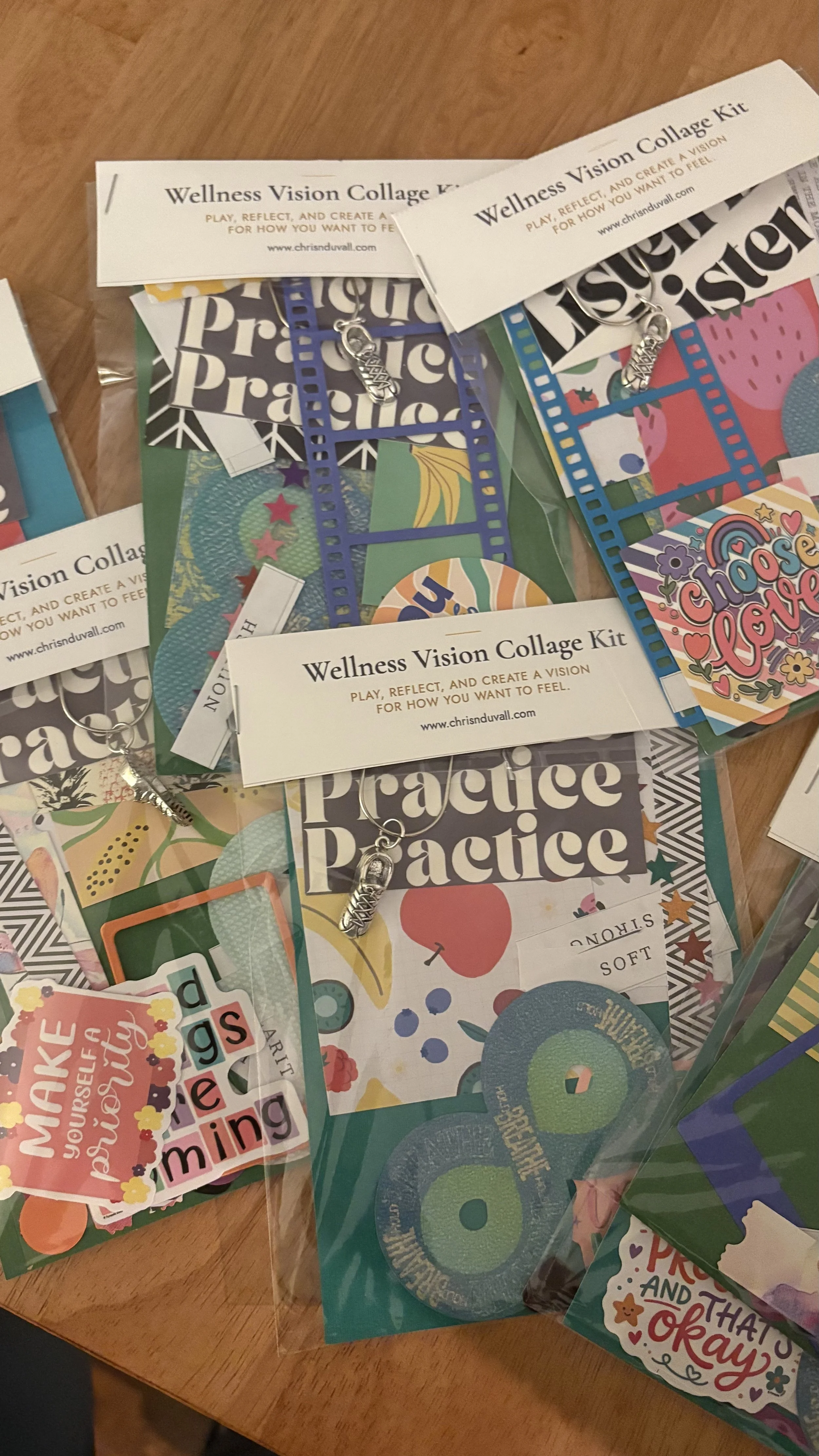
4. Make it visible. A vision you can't see is easy to forget. This is where I love a little hands-on creativity. Gather colors, patterns, and images that feel like your vision, not just look nice, and turn them into a small collage. Put it somewhere you'll see it every day: the fridge, your desk, your bathroom mirror.
If you'd like a head start, my wellness vision collage kit includes the papers and a prompt card to walk you through it.
Living with your vision
Writing it down is the start, not the finish. A wellness vision does its best work in ordinary moments.
Bring it out when you're making a choice: "Which option gets me closer to feeling grounded?" Bring it out on a hard day, not to judge yourself, but to remember the intention. Let it be the compass that reminds you, you are on the path. Bring it out when you feel off track, let it guide you back to center.
Your vision is also allowed to change. If a word stops fitting, rewrite it. That isn't failure. It means you've learned something about yourself, and your vision gets to grow with you.
Start with one sentence
You don't need a longer to-do list. You need a clearer picture of how you want to feel, and permission to let that picture guide you.
So here's my invitation. Before you close this page, finish this sentence:
I am…
If you'd like to go a little further, I'm putting together a guided wellness vision exercise that walks you through each step. You'll also get Gathered, my weekly note on connection, awareness, and being in relationship with your body. No pressure, no pitch. Just a little company along the way.